
FIGHTING SCREWWORM
THROUGH ECOLOGICAL RESILIENCE: National Strategy for Livestock Health, Biodiversity, Natural Pest Suppression, and Regenerative Grazing

Natalie M. Fleming
June 2026
What to do on the land while the federal response works:
soil, pasture, and husbandry that starve the screwworm of wounds.
Executive Summary
The New World screwworm has returned to the United States. On June 3, 2026, the USDA confirmed the first domestic case in roughly sixty years: a three-week-old calf in Zavala County, Texas, carrying larvae in its navel.[1] Within days, officials confirmed further detections across South and Central Texas and into New Mexico, including cases in a dog and a goat. On June 11, the CDC activated a Level 3 emergency response.[2]
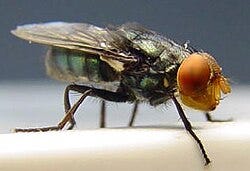
The pest had been held south at the Daréin Gap of Panama for decades. Its reemergence in Chiapas, Mexico, in November 2024 began a steady march north, reaching the southern border within eighteen months. More than 185,000 animal cases and 2,100 human cases have been reported across the region during this outbreak. The stakes reach every grazing region of the country: in Texas alone, economists estimate exposure at roughly $2.1 billion to the cattle sector and $9 billion to the hunting and wildlife economy, a single state’s slice of a threat that scales nationwide.
Federal response rests on five proven tools: surveillance, the sterile insect technique, veterinary treatment, animal movement controls, and targeted chemical suppression. These tools carry the eradication effort, and during an active outbreak they hold the front line. The most valuable habit a producer can adopt today stays simple and immediate: keep eyes on animals and report suspicious wounds the same day they appear.
The core insight
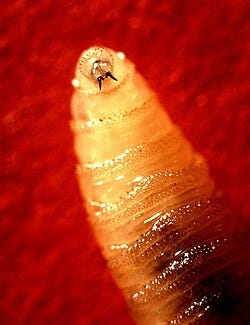
The screwworm makes its living on an opening someone else created. The female lays her eggs at the margin of an existing wound, and the larvae feed on living flesh, widening it as they go.
Most of those wounds trace to something earlier: biting flies, tick bites, brush and shearing cuts, birthing trauma, and above all the open navel of a newborn.
Close the wounds, time them away from the fly, and heal them fast, and the screwworm loses its doorway. That is the leverage this strategy is built on.
Regenerative agriculture has already solved hard pest problems by rebuilding the biological systems that hold pests in check. The same logic applies here, and much of it rests on solid evidence. This document lays out two reinforcing tracks. The first builds ecological pressure against the wound-causing insects: living soil, diverse pasture, dung beetles, and the birds and bats that eat flying insects by the thousand. The second changes how animals are bred, handled, and healed so that fewer wounds open during fly season at all. Both tracks reinforce veterinary medicine and sterile fly programs rather than replacing them. Sterile flies end an outbreak. Resilient land and sound husbandry lower the pressure that produces the next one.
Parts of this strategy rest on decades of field research and historical eradication experience, including seasonal birthing and dung beetle conservation. Other parts remain plausible hypotheses worth funded study, such as the idea that aromatic pasture plants lower screwworm pressure through scent. This paper marks that line throughout and gathers the open questions into a research agenda aimed at the USDA’s $100 million Screwworm Grand Challenge.
The Federal Effort and the Producer’s Part
The United States is already fighting this fly with the most effective tools ever built for it, and they belong to the federal government. The USDA pioneered the sterile insect technique, the method that cleared the screwworm from the country by 1966 and drove it south to Panama, where a joint United States and Panama commission has held the line for decades. That same machinery is running again. Since the June 2026 detections, USDA APHIS and its state partners have stood up a unified command, drawn 20-kilometer infested zones with quarantine and movement controls, and begun releasing millions of sterile flies a week by air and ground across the affected counties. A new production facility breaking ground in Texas will turn out hundreds of millions of sterile flies a week by 2027, the FDA has cleared emergency treatments for cattle, horses, dogs, and cats, and a federal Grand Challenge has put up to one hundred million dollars behind the next generation of tools. This is a serious, well-funded, expert response, and it carries the eradication.
Eradication is the federal job. The ground under each animal is the producer’s. While the sterile flies fly and the traps run, a rancher holds a different lever: the supply of wounds the screwworm needs to get started. Sterile releases thin the fly population from above; healthy soil, diverse pasture, dung beetles, insect-eating birds and bats, well-timed births, and prompt
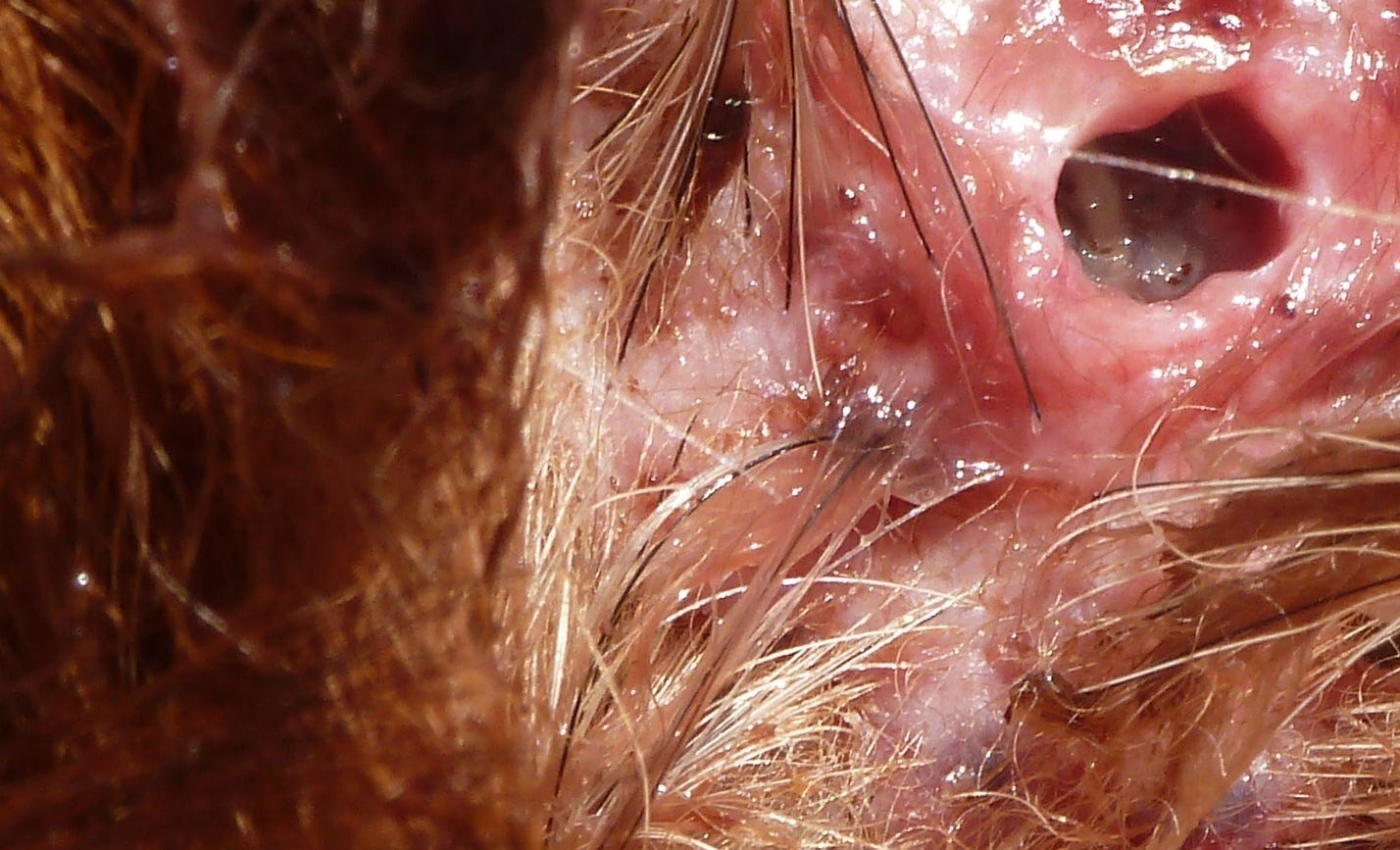
care close the openings from below. The two efforts drive in the same direction on different fronts.
So this paper is a guide for what to do on the land while the federal teams do their work. It asks one thing of every producer first, the step USDA leans on hardest: keep eyes on animals and report a suspected case the same day, because early detection is what lets the sterile-fly program corner an outbreak. Everything after that builds the kind of property where the fly finds little to exploit. The federal response buys time and pushes the fly back. The work on the land decides how much damage the fly does while that fight plays out, and how resilient the property stands when it is over.
Part I: Understanding the Problem
Sound strategy starts with an honest picture of the adversary and the route it takes into an animal. The two sections in this part describe the screwworm itself and the chain of events that usually comes before an infestation.
Understanding the Screwworm
The New World screwworm, Cochliomyia hominivorax, is a parasitic fly whose larvae feed on the living tissue of warm-blooded animals. The species name translates roughly to “man-eater,” and the common name comes from the way the ridged, spiral larva screws itself deeper into flesh as it feeds. This separates it from ordinary blow flies, which consume only dead tissue. A screwworm larva burrows into healthy flesh, enlarges the wound, and the odor of that growing wound draws still more egg-laying females.
Life cycle and the role of temperature
A female mates once, then seeks a wound or a moist body opening and deposits a shingled mass of two to three hundred eggs at its margin. The eggs hatch within a day, the larvae feed for five to seven days, and they drop to the ground to pupate in the soil. Adults emerge and travel to find mates and hosts. Speed depends on heat: above 80°F the cycle can complete in two to three weeks, while below 59°F development stalls and the fly goes effectively dormant.[3] That temperature dependence is the hinge on which much of the husbandry strategy in Part V turns.
How the adult finds a host
Adult screwworm flies are active by day and home in on hosts by smell, reading the scent of blood, decay, and wound secretions across a pasture. A property crowded with competing odors, thick with daytime insect predators, and short on open wounds reads as a poor target. A bare, predator-poor pasture full of wounded animals reads as an easy one. The fly hunts by nose in daylight, and that single fact shapes the predator, plant, and timing choices that follow.
Host range and why spraying alone falls short
The screwworm infests cattle, sheep, goats, horses, dogs, wildlife, birds, and people. That breadth is exactly why insecticide alone makes a weak primary defense: the fly breeds on deer and other wildlife far from any sprayer, so chemicals reach only a fraction of the host population.[4] Eradication through sterile flies remains the proven path. Everything else works by shrinking the wild population’s opportunities and easing animal suffering while the sterile program does its work.
Economic stakes
Before eradication, the screwworm cost US producers hundreds of millions of dollars a year. The campaign that removed it released more than ninety-six billion sterile flies between 1962 and the early 2000s and pushed the fly back to Panama, one of the most successful pest programs ever run. Re-establishment threatens direct animal losses, trade restrictions, surveillance costs, and the grinding labor of hand-inspecting every animal on a property. The USDA frames protection of the livestock sector as a national security priority and has opened a funding challenge of up to one hundred million dollars to expand sterile fly production and response tools.
The Wound Pathway
Few infestations begin with the screwworm. They begin with whatever broke the skin. Tracing that earlier chain shows where a producer can act long before a fly arrives.
The newborn navel: the deadliest doorway
The wet navel of a newborn calf, lamb, or kid is the single most dangerous entry point. Specialists describe the umbilicus as the leading route of infestation and cause of death in newborn livestock in screwworm-endemic South America, and the open vulvar tissue of the dam after birth runs a close second.[5] A navel that dries and heals quickly closes that doorway. A navel left wet through warm, fly-active weather invites the worst outcome the pest can deliver.
The everyday sources of a wound
Beyond birth, the recurring culprits split into living pests and the routine injuries of handling livestock. On the pest side: horn flies taking dozens of blood meals a day, biting stable and horse flies, mosquitoes, and ticks whose attachment sites linger. On the management side: barbed wire and brush cuts, shearing nicks, and the wounds left by castration, branding, dehorning, and ear tagging. Field experience during earlier outbreaks showed that an injury as small as a tick bite or a thorn scratch could seed a lethal infestation.
Awn-Bearing Grasses, Ranked by Risk
Plant awns belong high on that list, and a handful of grasses do real harm. Foxtail is the most notorious: the barbed awns of yellow foxtail and foxtail barley work like lawn darts, lodging in the tongue, gums, and cheeks, raising half-inch ulcers, and migrating through tissue into draining abscesses around the head.[6] Across the Great Basin and southern Idaho, two invasive annuals rival it for cumulative risk because they blanket whole ranges: cheatgrass and medusahead, each carrying stiff, barbed awns that injure the eyes, mouths, and noses of grazing animals.[7]
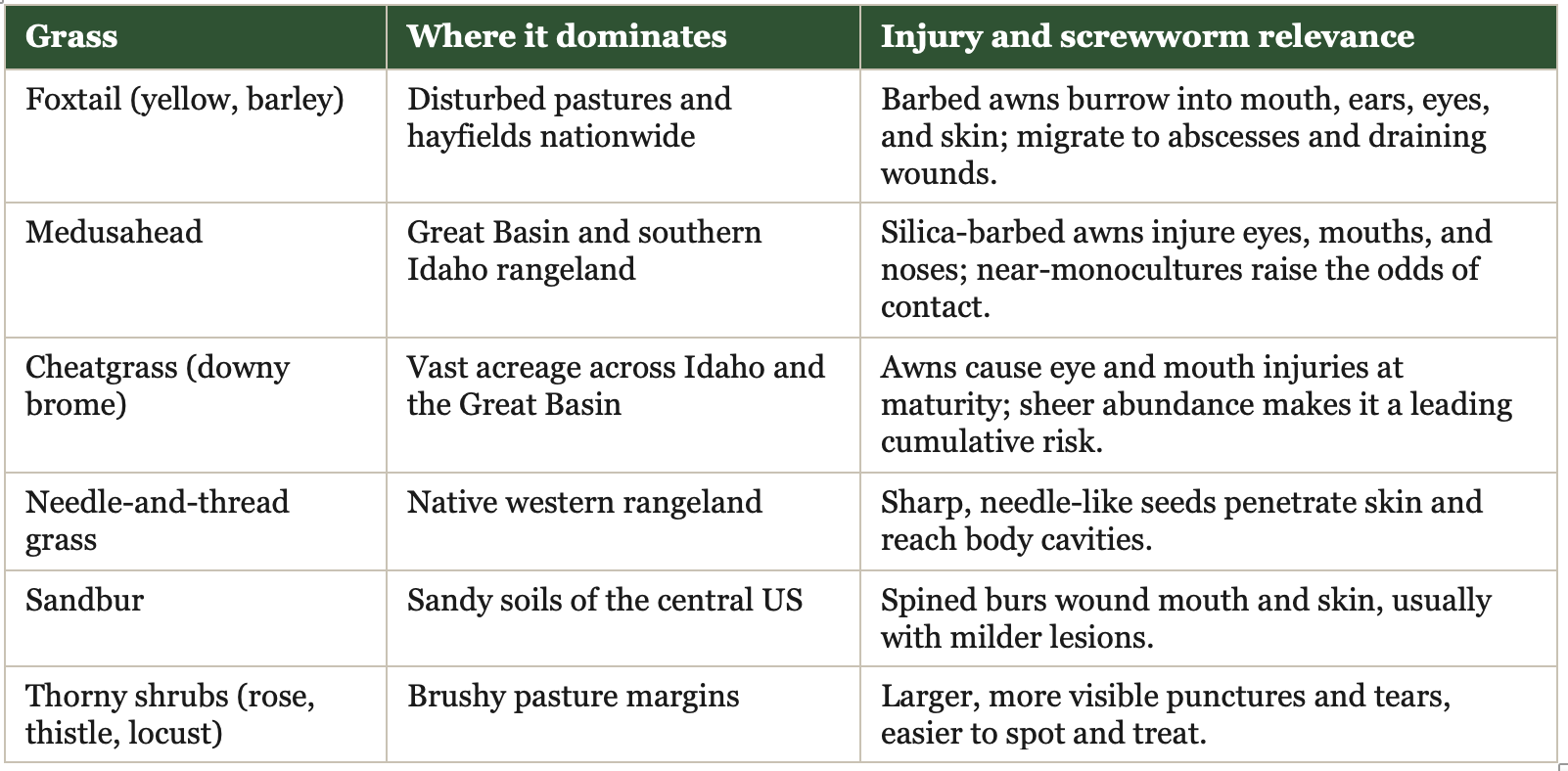
The annual grasses earn their rank through delay. An animal can carry an embedded awn for days or weeks before anyone notices, and by the time the wound surfaces it may already be inflamed, draining, and infected, the exact lesion a screwworm female seeks out. Detection is the countermeasure, and seed-head season is when it counts most.
Inspect during seed-head season
Check feet, ears, eyes, mouths, and noses on a regular schedule while grasses are heading out and curing.
Catching an awn early, before it migrates and the wound begins to weep, closes the doorway while it stays small.
These grasses reward the regenerative response because they are annuals that exploit thin, drought-weakened, freshly disturbed, or burned ground. A dense, diverse perennial stand is the documented barrier to cheatgrass and medusahead alike, so the competitive swards of Appendix A, paired with planned grazing that hits invaders early and mowing before the seed heads harden, crowd them out and strip the awns before stock ever graze them. Inspecting hay before feeding closes the winter route, since late-cut bales carry the same awns indoors. Good grazing and a thick sward turn a serious wound source into a manageable one.
The pathway, in one line
Biting insects, plant awns, and handling injuries → irritation and scratching → open wounds → screwworm opportunity.
Every arrow is a place to intervene. This strategy works on the left side of the chain, well before the final arrow, through fewer biting insects, better-timed and gentler handling, and faster healing.
Reading the pathway right to left changes the producer’s question. Rather than standing at the last arrow with a treatment for an infestation already underway, the work moves upstream: suppress the biting flies, schedule wounds away from the fly’s active season, calm the handling that causes injuries, and speed every wound toward healing. The rest of this document follows that upstream logic.
Closing the Common Wound Sources
The awn grasses are one family of wound source among several. Four more recur on most operations, and each yields to management a producer already knows. Closing them shrinks the supply of open skin before the ecological work of the later parts even begins.
Ticks: A Thousand Small Wounds
A heavy tick burden punches hundreds of tiny holes in an animal’s hide, and each attachment site is a candidate screwworm wound. Ticks also ride deer and other wildlife, the same reservoir that carries the fly, so the two problems travel together. Pressure comes down through several moves at once:
• Guinea fowl and free-ranging poultry work pasture and brush edges, taking ticks off the ground directly.
• Insectivorous birds, drawn by the nest boxes of Part IV, add steady daily predation.
• Rotational and prescribed grazing breaks the tick cycle by moving animals off infested ground and grazing down the tall, brushy cover where ticks wait to climb aboard.
• Mown, open loafing areas, fence lines, and bedding spots deny ticks the humidity and questing perches they depend on.
• Managing deer pressure around calving pastures and water cuts the wildlife traffic that seeds both ticks and screwworm.
Each tick site closed is one fewer doorway, and the same grazing and habitat tools carry the rest of the strategy forward.
Fences, Troughs, and Handling Equipment
Ranch hardware injures stock daily. Barbed wire tops the list: animals hit fences in storms, predators push them through, and calves and goats tangle in the strands. Smooth high-tensile or high-visibility wire spares much of that damage, and a standing fence-walking and repair schedule catches the protruding staples and broken wire that open hide. Water troughs and handling equipment earn the same eye, since sharp tank edges, rusted seams, broken floats, and crowded chutes all cut and bruise. Smooth, maintained surfaces and the calm, well-designed handling of Part V turn routine infrastructure from a wound source into a neutral one.
Brush and Thorn
Thorny brush tears hide as animals push through it for shade, browse, or escape. Mesquite and multiflora rose rank among the worst, with dense blackberry and thistle adding their share. Targeted browsing by goats, who relish the brush cattle avoid, holds thickets back, while clearing the heaviest patches and opening travel lanes and shade keeps stock off the thorns. Steering animals away from heavy brush during fly season, and clearing it from the places they gather, removes a wound source that otherwise scratches a fresh opening every day.
Rubbing Plants and Self-Anointing
Livestock rub to relieve fly and lice irritation, and a poor surface leaves them raw, which opens the very wound the rubbing was meant to soothe. Two kinds of plant turn that urge to advantage. Sturdy woody plants give a safe surface that spares hide and fence: willow bends under a half-ton animal and springs back, regrowing after the punishment, while established shelterbelt trees and, across Idaho range, mature sagebrush and juniper stand up to a hard scratching. Set a few rub-worthy trees or a stout brush row where the herd already gathers, near water and shade, so they work the plant instead of the wire.
Aromatic plants do more, rubbing a film of insect-repelling oil onto the coat. Cats show the mechanism plainly: they rub against catnip and silver vine, transfer nepetalactone onto their fur, and that compound drives off mosquitoes.[8] Catnip oil tested about ten times stronger than DEET in repellency trials, so catnip is the plant to seed for this, with wild bergamot, anise hyssop, hyssop, lemon balm, sage, and thyme carrying related oils and sagebrush and juniper offering it natively.[9]
One caution holds. A few of the strongest repellent plants, tansy, pennyroyal, and some wormwoods, turn toxic when an animal eats much of them, so keep those out of grazed paddocks. The plants named above stay safe to both rub and nibble in normal pasture amounts. The self-anointing chemistry is proven and the repellent compounds are real, while direct trials on cattle rubbing for fly control remain thin, so treat the aromatic rubs as a cheap layer to test rather than a settled cure.
Part II: Ecosystem-Based Livestock Protection
Moving Beyond Single-Pest Thinking
Single-pest thinking asks how to kill the screwworm. During an outbreak that question matters, and the sterile insect technique answers it well. As a standing posture for a whole operation, it leaves a producer lurching from one emergency to the next, reaching for a chemical each time a count climbs, and against this particular fly the chemical reaches only part of the host population anyway.
Ecosystem thinking asks a different question: why does a property generate so many wounds, pest surges, and weak animals, and how can those conditions grow rare? The answers live in soil, plant diversity, insect predators, grazing, and the timing of husbandry. Build those, and pest pressure falls as a byproduct of a healthier system. The screwworm becomes one of several threats a resilient property quietly holds down rather than the emergency that defines the year.
Two questions, two postures
Reactive: “How do we kill this pest right now?” Essential in a crisis, exhausting as a way of life, and limited against a fly that breeds on wildlife.
Resilient: “How do we build conditions where wounds, pest surges, and weak animals grow uncommon?” Slower to take hold, durable once it does.
Healthy Soil as the Foundation
Everything upstream of the screwworm begins in the soil. Living soil, rich in bacteria, fungi, earthworms, and the deep filaments of mycorrhizae, cycles nutrients into forage, holds water through dry spells, and supports the plant diversity the rest of the strategy depends on. The dung beetles that suppress flies breed in that soil. The deep-rooted plants that carry trace minerals to grazing animals draw them up through it.
The benefits run in a chain that reaches all the way to a healing wound:
• Active microbial life and nutrient cycling, which lift forage quality and an animal’s mineral status.
• Strong water infiltration, which carries pasture through drought and spares animals the stress that weakens immune defenses.
• Habitat for earthworms and dung beetles, the engines of manure recycling and fly suppression.
• A root environment that sustains deep-rooted, diverse plant communities.
A well-nourished, unstressed animal heals faster and scratches less. Soil health and wound resilience are the same project seen at two scales, and the second track of this strategy, in Part V, picks up the animal end of that chain directly.
Diverse Pastures as Living Infrastructure
A diverse pasture works as built infrastructure. It cycles minerals, resists drought, feeds beneficial insects, and keeps animals in better flesh than any monoculture manages. The goal is a layered plant community where each layer supplies what the others lack. Regional species vary, so the lists below mark starting points rather than prescriptions.
Grass layer
Productive, palatable grasses form the base: orchardgrass, timothy, meadow brome, and regionally adapted natives. They carry the bulk of the forage and armor the soil surface against erosion and crusting.
Legume layer
Legumes fix nitrogen, raise protein, and feed pollinators when they bloom: white, red, and alsike clover, alfalfa, and sainfoin. Sainfoin and other tannin-bearing legumes add a direct screwworm-relevant benefit, since their condensed tannins lower internal parasite burdens, and a less parasitized animal holds condition and scratches itself raw far less often.
Deep-rooted forb layer
Chicory, plantain, and yarrow mine minerals and moisture that shallower plants miss, support animal health, and break up the soil with varied roots. Chicory and plantain also carry bioactive compounds associated with lower worm burdens. Their contributions read like a summary of what diversity buys:
• Mineral cycling from deep in the profile up to the grazing surface, supporting skin integrity and wound healing.
• Drought resilience through a spread of rooting depths.
• Soil structure and soil life fed by root diversity.
The Aromatic Herb Layer
This section rests on a hypothesis rather than settled science, and the paper treats it that way. The screwworm hunts by scent. A pasture salted with strongly aromatic plants may present a muddier chemical picture to an egg-seeking female while feeding pollinators along the way. Candidates adapted to grazing include wild bergamot, anise hyssop, catnip, lemon balm, hyssop, thyme, and sage.
The proven benefits of these plants are real: pollinator forage, habitat for beneficial insects, and added diversity in the sward. The proposed benefit, measurable suppression of screwworm egg-laying through scent, awaits direct study. A producer can plant them for the proven reasons and treat any scent-confusion effect as a bonus to be tested.
Evidence status: aromatic herbs
Proven: pollinator and beneficial-insect support, added plant diversity, palatability of several species to grazing animals.
Hypothesized: direct interference with screwworm egg-laying through scent complexity. Framed as a research question in Part X.
Insectary Plants
Insectary plants earn their keep by feeding the predators and parasitoids that control pest insects. Flowering dill, fennel, buckwheat, cilantro, and sweet alyssum supply nectar and pollen to lacewings and hoverflies, whose larvae devour soft-bodied pests, to lady beetles, and to the small parasitic wasps that attack fly pupae. Scattering insectary strips through and around pasture keeps these allies present and breeding before pest numbers climb, so the predators arrive early rather than too late.
Honesty requires a caveat. While parasitoid wasps and predatory insects clearly contribute to fly control, researchers caution that the field evidence for predators and parasitoids single-handedly suppressing pasture fly populations stays inconclusive.[10] Insectary plants belong in the strategy as one reinforcing layer, valuable alongside dung beetles and aerial predators rather than as a standalone fix.
Part III: Natural Pest Suppression
Dung Beetles
Dung beetles are the strongest evidence-based link between biodiversity and reduced fly pressure, and they deserve top billing. A single cow pat left undisturbed can hatch sixty to eighty horn flies. A good populations of dung beetles bury and shred that pat within an hour to day or two, competing with fly larvae for food and destroying their eggs in the process. Fewer horn flies means less biting, less self-trauma, and fewer of the small wounds a screwworm can exploit.
The numbers are striking. Classic work found ninety-five percent fewer horn flies emerged from cow pats colonized by the beetle Onthophagus gazella than from pats where beetles were excluded.[11] A silvopasture study recorded forty percent fewer horn flies on cattle than on open pasture, with more dung buried per beetle.[12] Pastures lacking a working beetle community can lose roughly thirty percent of forage production to unburied, volatilizing manure, so the beetles pay their way twice over.
Their benefits stack across the operation:
• Manure burial that starves horn fly and face fly larvae of breeding habitat.
• Nutrient cycling and better soil structure as beetles work organic matter downward.
• Improved water infiltration through the burrows they leave.
• Lower survival of ruminant-parasitic nematodes, which eases the parasite-driven irritation that opens skin.
The Chemical Feedback Loop
Here the strategy meets its sharpest tension, and recent research has sharpened the picture. Broad-spectrum parasiticides and feed-through insecticides pass through the animal into the manure, where they kill the dung beetles that would otherwise suppress flies. The chemical aimed at the pest removes the pest’s natural enemy.
A 2025 Cornell study found dung beetle abundance and diversity markedly lower on farms using feed-through insecticides than on farms that left them out, and warned that routine use may reinforce the very fly problem it targets.[13] Macrocyclic lactone dewormers such as ivermectin can stay lethal to beetles in manure for one to three weeks after a single treatment.
The loop, named plainly
More flies prompt more chemical. More chemical kills more dung beetles. Fewer beetles leave more manure exposed. Exposed manure breeds more flies. More flies prompt still more chemical.
Break the loop at the beetle: treat by threshold rather than by the calendar, favor targeted tools such as back rubbers, dusters, and walk-through fly traps over feed-through products, and choose beetle-safer compounds such as moxidectin where a parasiticide is warranted.
Breaking the loop reduces reliance on intervention rather than abandoning it. Cornell extension pairs this with concrete action thresholds: treat near two hundred horn flies per animal and ten face flies per animal, so chemical use becomes a measured response instead of a habit. Walk-through vacuum traps have cut horn fly numbers by forty to seventy percent in trials, offering real suppression with no cost to the beetles.
Daytime Predators
Because the screwworm flies by day, day-hunting insectivores meet it in its active hours. Aerial-feeding birds patrol the airspace over pasture and take large numbers of flying insects, including the biting flies that open wounds. Encourage barn, cliff, and tree swallows, purple martins, the kingbirds, and Say’s phoebes. A single nesting pair feeding young can pull thousands of insects a day from the air above a paddock, and a martin colony multiplies that many times over.
Nighttime Predators
Bats extend insect control through the dark, covering the hours when birds roost. Big brown bats, little brown bats, and Mexican free-tailed bats each consume large volumes of flying insects nightly, and a sizable colony clears an enormous tally from the air over a property. Day-flying birds and night-flying bats together give an operation close to round-the-clock aerial suppression of the insects that drive wound formation.
Mechanical Fly Trapping
Traps pull biting flies out of the air at no cost to the dung beetles or predators that the chemical route harms. A walk-through trap set in a gateway brushes horn flies off cattle as they pass and has measurably reduced horn fly loads in field trials. Sticky and box traps tuned to specific pests, the Nzi and canopy traps for stable and horse flies and simple horn fly traps for the rest, thin the biting population that opens wounds. Trapping pairs naturally with the bird, bat, and beetle work of this strategy, adding a mechanical layer whose value climbs right when fly pressure peaks.
Part IV: Habitat Infrastructure
Predators settle and stay where habitat invites them. This part treats nest boxes, roosts, perches, hedgerows, and water as working ranch infrastructure, placed as deliberately as fences and waterers.
Bird Houses as Ranch Infrastructure
Nest boxes turn open pasture into breeding habitat for the insectivores of Part III. Sited along fence lines, near water, through hedgerows, and within silvopasture, and sized for the target species, boxes draw swallows, bluebirds, flycatchers, and purple martins onto ground where their appetites do the most good. A few dollars of lumber per box, distributed widely, recruits a self-renewing workforce that returns year after year. Purple martin houses in particular reward the effort, since a single colony concentrates a large number of aerial feeders over one property.
Bat Houses as Ranch Infrastructure
Bat houses do for the night shift what nest boxes do for the day. Mounted near water, along pasture edges, beside irrigation corridors, and within hedgerows, well-built roosts give bats a reason to settle and hunt over a property rather than pass through. Spread widely, they deliver nighttime insect control across the whole operation at a trivial running cost, and they pair naturally with the water features described below, which supply the insects bats hunt.
Perches
Simple perches multiply a predator’s reach. Posts and crossbars in open pasture give kingbirds and flycatchers a launch point for catching flying insects, while taller raptor poles invite hawks and owls to patrol for rodents and large insects. A perch costs almost nothing and converts empty airspace into hunting ground, a high return for a post and a crossbar.
Hedgerows and Wildlife Corridors
Hedgerows knit the system together. A planted line of shrubs and trees supplies nesting cover for birds, season-long forage for pollinators, and refuge for beneficial insects, while breaking wind and linking habitat patches so wildlife can move across a property. The benefits compound:
• Nesting and roosting habitat for insectivorous birds.
• Pollinator forage and refuge for beneficial insects through the season.
• Wind protection that lowers animal stress and slows forage desiccation.
• Connected corridors that let predators and pollinators move and persist.
Water Features
Water concentrates life. A pond, a wetland edge, or a well-managed water point draws birds, bats, dragonflies, and pollinators, and dragonflies in both their aquatic and adult stages rank among the most effective predators of flying insects alive. Placed thoughtfully and kept clean, water features become biodiversity hotspots that feed the rest of the strategy. Clean, moving, or well-vegetated water also denies mosquitoes and certain nuisance flies the stagnant breeding sites they prefer, turning a potential liability into an asset.
Part V: Animal-Centered Regenerative Practices
The land-and-habitat work lowers the number of biting insects. This part lowers the number of wounds those insects and routine handling leave behind, and times the unavoidable wounds away from the fly. These husbandry practices sit at the heart of regenerative management already, and several rank among the best-documented screwworm defenses in the historical record.
Seasonal Breeding and Birthing
This is the single most powerful regenerative lever against the screwworm, and the evidence behind it is strong. During the original US eradication, producers timed breeding so that most young arrived in the cold months, when fly activity fell to near zero and the vulnerable navel healed before the fly could reach it.[14] Extension services are recommending the same approach again now, advising producers to align breeding and birthing with cooler months and to define a breeding season rather than leaving sires with females year-round.[15]
Regenerative graziers already practice defined, seasonal calving and lambing matched to the forage curve, so this asks for a shift in timing rather than a new system. The fit is close to perfect: a tight breeding window concentrates births into the cool season, which serves grass-fed economics, eases labor, and closes the fly’s deadliest doorway in one move. The practice carries real tradeoffs to manage, including dam nutrition through winter, cold exposure for newborns, and predation risk for lambs and kids, so each operation balances them against its own conditions.
Why timing beats almost everything else
The navel is the number-one fatal entry point in newborns. A calf born in December heals its navel during dormant-fly weather; a calf born in July heals it under active screwworm pressure.
Below 59°F the fly’s life cycle stalls. Birthing into that window removes the host’s most vulnerable moment from the fly’s active season entirely.
Timing Wound-Causing Work
The same temperature logic applies to every planned wound. Castration, branding, dehorning, ear tagging, tail docking, and shearing all create openings, and extension specialists advise scheduling them for the cool months when flies are inactive, as early in spring or as late in fall as the work allows.[16] Fiber animals need extra diligence, since shearing nicks are a classic screwworm site and the work cannot always wait for cold weather.
Where a procedure must happen during fly season, the regenerative response leans on the rest of this strategy: do the work on clean pasture, keep treated animals close to handling facilities for daily checks, dress the wound, and watch it until it closes. Some operations are also reviving low-wound alternatives, such as banding in place of surgical castration and polled genetics that retire dehorning altogether, which removes the wound rather than merely timing it.
Multispecies and Cross-Species Grazing
Running more than one species, or grazing them in sequence, breaks parasite cycles because most internal parasites are host-specific. Cattle ingest and dead-end the larvae that target sheep and goats, and small ruminants return the favor, so each species cleans the pasture for the other.[17] Lower parasite burdens mean animals that hold condition, heal well, and scratch and rub far less, which closes another route to open skin.
Mixed grazing also uses forage more completely and spreads grazing pressure across more plant species, reinforcing the diversity goals of Part II. Add guinea fowl or chickens to the mix and the operation gains tick and insect predators that work the pasture surface directly, though the manure-sanitation claims for poultry deserve the closer look in the next section.
Poultry Behind the Herd
Running poultry a few days behind grazing livestock is a signature regenerative practice, popularized by mobile hen housing that follows the herd. The idea is sound on its face: chickens and ducks tear into manure pats hunting fly and worm larvae, scatter the pats to dry in the sun, and pick biting flies off the ground and the animals.[18] The honest verdict is that the evidence stays mixed. A controlled trial found pastured broilers failed to reduce face fly larvae survival, mainly because the birds refused to forage in dung pats once solar radiation climbed and instead rested in shade.[19]
The practice still earns a place, with realistic expectations. Foraging breeds rather than meat broilers, shade and water that keep birds active through the day, and a role framed as one sanitation layer among several will serve better than treating the flock as a fly cure. The eggs and meat add an income stream regardless, which is reason enough for many operations to keep birds on the land.
Silvopasture and Shade
Integrating trees with pasture pays the screwworm strategy on three counts at once. Shade lowers heat stress, which keeps animals calmer and reduces the bunching and agitation that spread biting flies and cause injuries. The silvopasture fly study already cited recorded about forty percent fewer horn flies on cattle than open pasture. And the trees themselves become vertical habitat for the insect-eating birds and bats of Parts III and IV, with cavities, perches, and roosts built in. A shaded, tree-studded pasture is cooler, calmer, lower in biting flies, and richer in predators than the bare paddock beside it.
Nutrition and Wound Resilience
A well-fed animal is a hard target. Trace minerals carried up through diverse, deep-rooted forage, zinc and copper chief among them, are the raw material of skin integrity and fast wound healing, and an animal in strong condition mounts a better response to any breach in the skin. Diverse pasture, the tannin-bearing legumes and bioactive forbs of Part II, and a sound mineral program together build animals whose wounds close quickly and whose coats and skin resist the small injuries that start the pathway. The soil-health work of Part II and the animal-health payoff here are two ends of the same chain: healthy ground grows the minerals that heal the wound.
Low-Stress Stockmanship
How animals are handled decides how many wounds handling creates. Calm, deliberate stockmanship and well-designed facilities cut the bruising, cuts, and crowding injuries that come with rough or rushed work. The historical screwworm literature credits careful handling and improved husbandry with removing several of the predisposing causes of infestation outright. Fewer panic injuries, gentler restraint, and patient movement through good facilities mean fewer wounds for the fly to find, and calmer animals carry better immune function and condition into the bargain.
Part VI: Pasture Renewal and Continuous Improvement
Diversity is built, then maintained. This part covers the grazing and seeding methods that raise plant variety, spread fertility, and let pasture recover, keeping the living infrastructure of the earlier parts growing stronger each year.
Rotational Grazing
Rotational grazing is among the best-supported practices in this paper, and it touches the screwworm at several points. Moving animals through paddocks on a planned schedule lets forage recover, spreads manure and urine evenly, and concentrates dung in ways that favor beetle colonization. Timed moves also carry animals off contaminated ground before parasite larvae mature, breaking the worm cycle that drives irritation and scratching. The gains are practical and well documented:
• Better forage recovery and higher total production across the season.
• Even nutrient distribution across paddocks.
• Rising plant diversity as rest periods favor a wider mix of species.
• Lower internal parasite pressure through well-timed moves and adequate rest.
Animal-Assisted Reseeding
Livestock can plant pasture as they graze. Hooves press seed into the soil, manure and urine fertilize the seedbed, and animal traffic creates the seed-to-soil contact germination requires. Working with this behavior turns a herd into a low-cost seeding and fertility crew that establishes new species as a routine part of grazing rather than a separate expense.
Seeding Before Grazing
Broadcasting seed onto a paddock just before animals enter lets their hooves do the planting. The herd treads seed into soil contact, leaves fertility on the spot, and moves on. This timing suits larger seed and situations where trampling improves establishment.
Seeding After Grazing
Seeding right after a graze takes advantage of freshly opened ground. With the canopy grazed down, new seed reaches more sunlight and meets less competition during the vulnerable establishment window. This timing suits species that struggle to push through a thick standing sward.
Combining Both Approaches
The two timings work best together, bracketing a graze with seeding on both ends and then resting the paddock:
1. Seed before grazing, so hooves press the first sowing into the soil.
2. Let the herd graze and trample, planting that seed and depositing fertility.
3. Seed again after grazing, onto freshly opened ground.
4. Rest the paddock through a long recovery period to let establishment take hold.
Frost Seeding
Frost seeding uses winter’s freeze-and-thaw to work seed into the soil at almost no cost. Broadcast onto frozen ground in late winter, seed settles into the cracks that open and close as the soil heaves, reaching contact without tillage. The method suits small, hard-coated seed: clovers, chicory, plantain, and alfalfa establish well this way across many regions.
Bale Grazing
Feeding hay in the pasture over winter seeds and fertilizes the ground beneath it. Each bale leaves spilled seed, concentrated manure and urine, and a mat of organic matter that becomes a fertility hotspot by spring. Spread bale feeding across a property and these spots grow into islands of diversity and biological activity:
• Fertility hotspots from concentrated manure, urine, and waste hay.
• Seed dispersal from the hay itself.
• Organic matter accumulation that feeds soil life.
• Biodiversity islands that spread outward over time.
Continuous Diversity Building
Diversity grows through steady, repeated effort rather than one grand planting. Annual overseeding, a little new genetics added each year by whichever method fits the season, compounds into richer pasture over time. Each pass adds plant diversity, pollinator forage, soil resilience, and ecological function, and the property grows more capable of suppressing pests on its own with every cycle.
Part VII: Operational Protocols and Preparedness
The ecological and husbandry work lowers the odds of a wound. When one opens anyway, a short set of protocols decides whether it heals clean or turns into a case. These steps complement the federal response and the veterinarian rather than standing in for either.
Newborn and Navel Care
The newborn navel is the deadliest doorway, so it earns a protocol of its own. Calve, lamb, and kid on clean, dry ground, dip or spray each navel with a chlorhexidine or iodine solution at birth, and repeat until the cord dries. Check newborns daily through their first weeks, and during an active outbreak keep the youngest stock close enough for a hands-on look. A navel that dries fast shuts the window before the fly arrives.
Finding and Treating a Wound
Speed decides the outcome. A found wound calls for a fixed sequence, with one step that overrides the rest: a suspected screwworm case is a reportable event, and the call goes out the same day.
Wound response, in order
1. Clean the wound and clear debris so the tissue is visible.
2. Inspect closely for larvae or eggs, above all around body openings: nose, ears, genitalia, and the navel of newborns.
3. Dress and treat with a product your veterinarian directs, since the FDA has authorized specific drugs for screwworm under emergency use.
4. Monitor daily until the wound fully heals, keeping the animal where you can watch it.
5. Report a suspected screwworm wound immediately to your veterinarian, state animal health official, or USDA. This step is mandatory.
One nuance from USDA carries real weight: watch the animals, not the flies. Many flies look alike, and a screwworm fly in an eradication area may be a harmless sterile release, so a careful wound check beats fly-spotting every time.[20]
Biosecurity and Animal Movement
Animals carry the fly between properties, so movement is a control point. Inspect every animal before transport and on arrival, hold new and returning stock (show and sale-barn animals included) apart until you have looked them over, and respect the movement controls inside any USDA infested zone, where warm-blooded animals stay put without prior authorization and an inspection.[21] A few minutes at the trailer closes a route the fly otherwise rides for free.
Wildlife Surveillance
The screwworm breeds on deer and other wildlife, so a property’s watch reaches past its own herd. Note wounded or maggot-ridden wildlife, report suspicious wild cases to USDA Wildlife Services at 866-487-3297, the nationwide line, and fold trail cameras and hunter observation into the watch through fly season. Hunters and landowners who know the signs become extra eyes across country no inspector can cover.
Part VIII: A National Biodiversity Strategy
Diversity as Ecological Infrastructure
Scaled to the nation, the principle holds: the goal is maximum ecological function rather than any single favored species. A system carried by one organism fails when that organism does. A system carried by many has redundancy built in, so when one control falters, others carry on. More species deliver more resilience, more redundancy, and more stability. A national effort should measure success by functional diversity rather than by the presence of a particular plant or beetle.
Regional Adaptation
A national strategy works only when it bends to local conditions. The plant mixes, predator species, breeding calendars, and seeding methods that thrive in Idaho differ from those suited to the Texas brush country, the Florida flatwoods, or the Maine uplands, and the cool-season birthing window itself shifts with latitude and elevation. The principle travels even where the species list and the calendar change: maximize functional diversity with locally adapted plants and native predators, and time vulnerable events to each region’s low-fly season. A federal framework supplies the principle and the research; each region supplies the specifics.
Part IX: The Resilience Dividend
This program’s value reaches well past the screwworm. If the fly vanished tomorrow, most of these practices would keep paying their way, because each one is an asset with many outputs at once. A dung beetle buries manure, cycles nutrients, suppresses flies, and opens the soil to water in a single act. A diverse pasture feeds animals, fixes nitrogen, blooms for pollinators, and holds moisture through a drought. Building those assets buys a whole portfolio of returns, and the screwworm is one line on the ledger.
Regenerative agriculture is resilient agriculture. The ranchers already grazing in rotation, building diverse pasture, and protecting their dung beetles entered the screwworm era with an ecological advantage, since their land already suppresses pests, holds water, and resists fire. The fly merely made that advantage visible. For everyone else, the screwworm arrives as one more reason, stacked on drought, input bills, and wildfire, to opt in now.
One Investment, Many Returns
The same handful of practices, healthy soil, diverse pasture, dung beetles, insect-eating birds and bats, planned grazing, and trees in the pasture, throw off returns across the whole operation. The table arrays the largest of them.
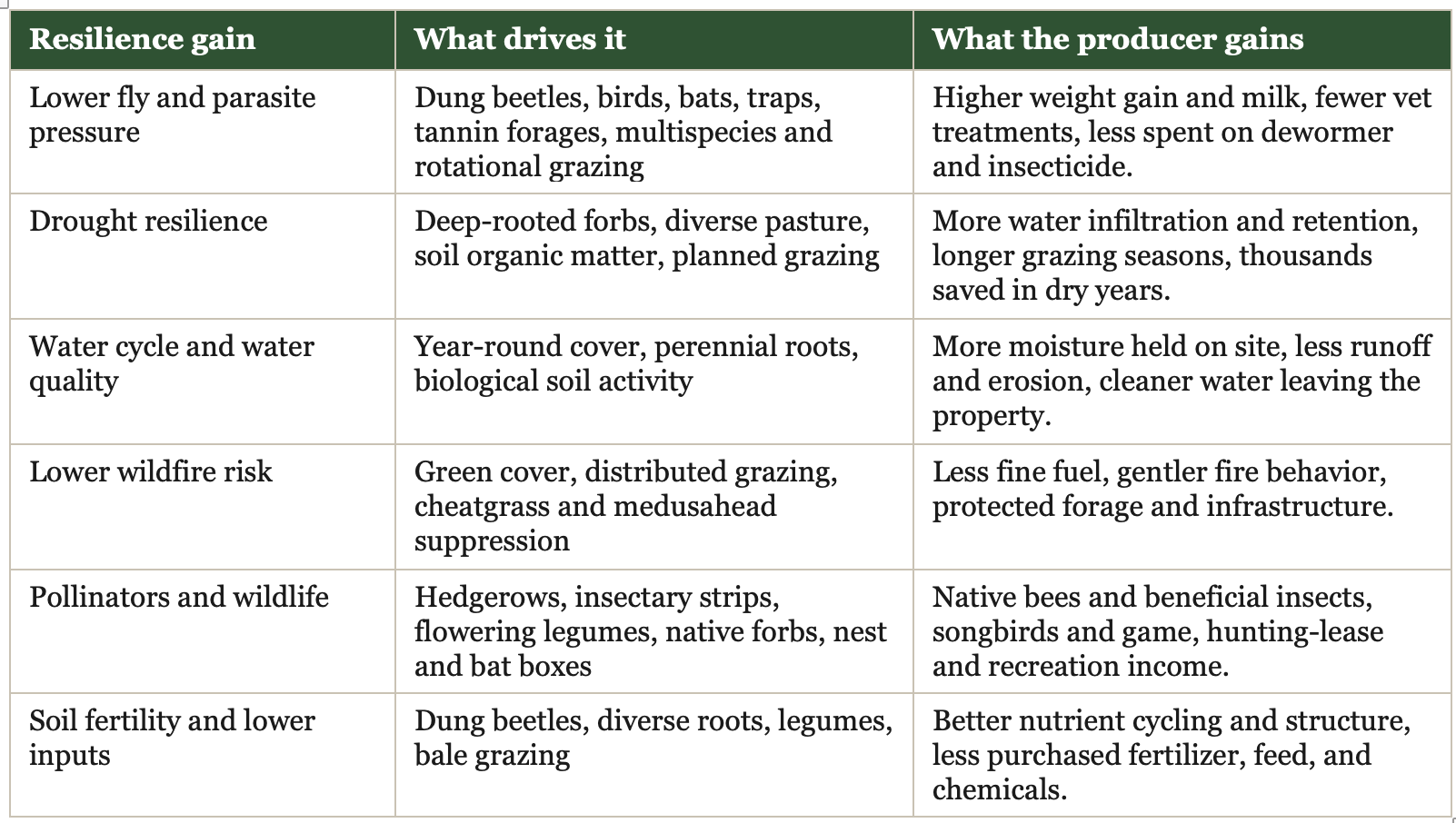
The Water Cycle and the Dry Years
For many producers the drought benefit will outrun the screwworm benefit in plain dollars. Deep-rooted, diverse pasture over living soil drinks in rain rather than shedding it, banks it in organic matter, and carries forage weeks longer into a dry spell. Those same gains in cover and infiltration feed the water cycle at a reach past any single ranch: more rain soaks in, more cycles through plants back to the air, and more lingers in the ground between storms. Soil carbon builds alongside, through deeper roots and steady perennial cover, though the water story is the one that pays the rancher first. Cleaner water leaves the property as well, since a thick sward filters runoff and pins soil in place, easing the sediment load on every stream downstream.
Fire and the Annual Grasses
The grazing and cover that shut out cheatgrass and medusahead also starve a wildfire of its fuel. Those annual invaders cure into fine, flammable thatch that shortens the fire-return interval across the Great Basin, and each burn opens more ground for the next invasion.[22] Planned grazing that favors competitive perennials, the same work that strips awns before they wound stock, breaks that loop with greener cover, distributed grazing, and lower fuel loads through the dangerous months. The awn-injury fix and the fire fix turn out to be one fix.
The Case for Opting In
The strongest argument for this program may rest on its breadth rather than on the screwworm alone.
The argument in one line
Even if it trimmed screwworm risk only modestly, this program would earn its place, since it builds soil health, drought resilience, wildlife habitat, pollinator numbers, parasite control, water retention, animal welfare, and ranch profit in the same stroke.
That case holds in any year. The screwworm only adds urgency to a choice the dry years and the input bills were already pressing.
Producers already on this path hold the advantage now, and the rest can join them. Opting in to regenerative agriculture is opting in to resilient agriculture, with the screwworm standing as one threat among many that a living, diverse, well-grazed property quietly holds down.
Part X — Research Agenda
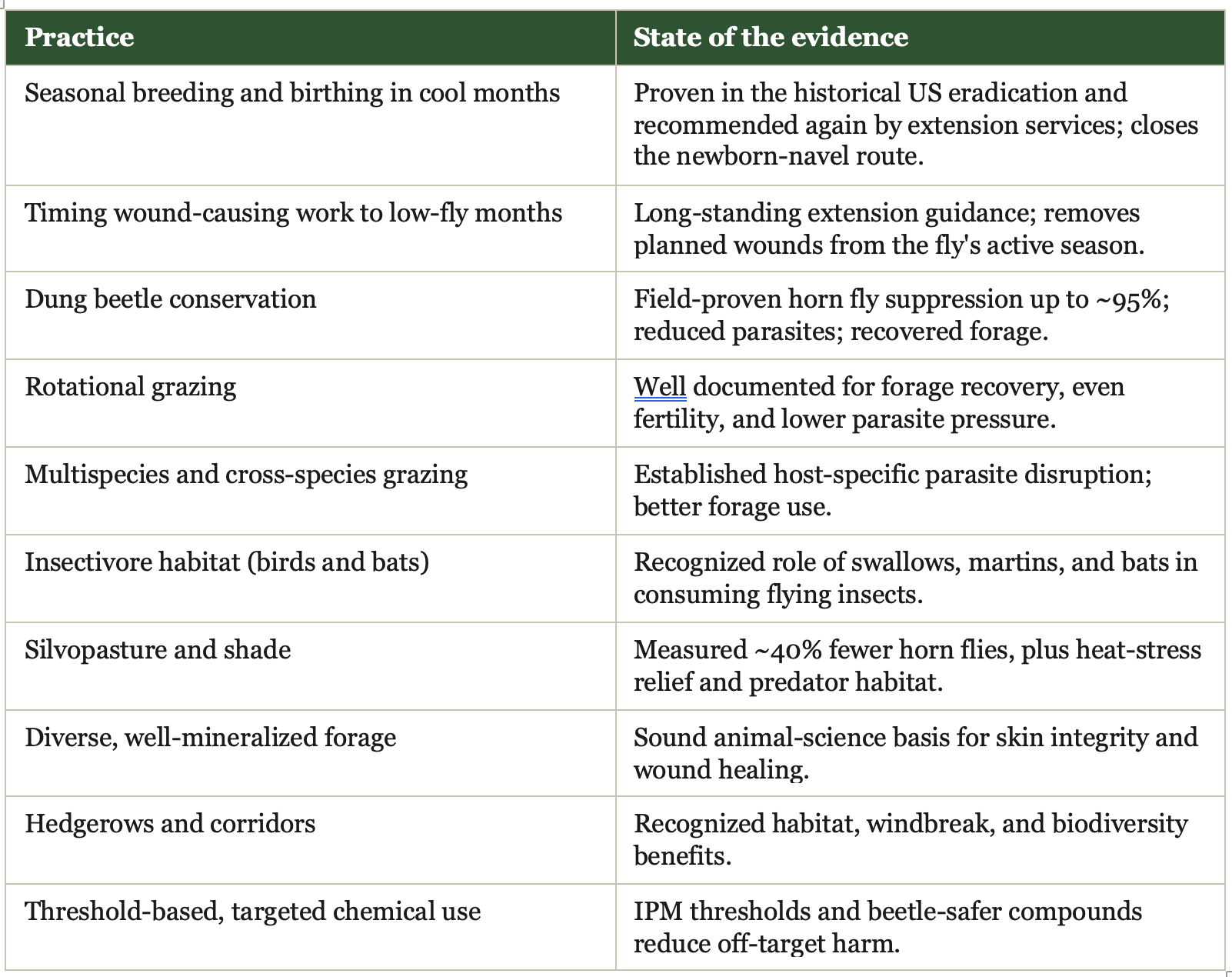
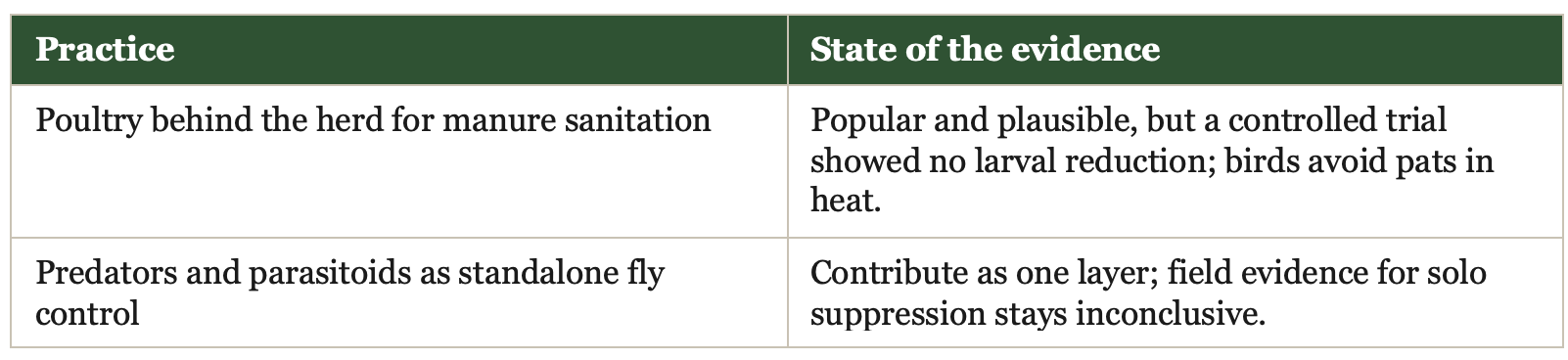
Intellectual honesty is the spine of this strategy. Some practices rest on decades of evidence and historical eradication experience and can be recommended now. Others are plausible hypotheses that deserve funded study before anyone leans on them. The table below draws that line, and the USDA’s New World Screwworm Grand Challenge, with up to one hundred million dollars for innovative work, offers a natural home for the open questions.
The wound-ecology gap
Federal work concentrates on the fly: sterile releases, trapping, detection, genetics, and treatment, and that work is essential.
The matching question stays wide open: how to cut the creation of wounds in the first place. Wound ecology, the study of where livestock wounds come from and how management lowers them, is the contribution this paper presses for.
Where the evidence is strong
Where evidence is mixed or thin
Open questions worth funding
These sit at the heart of the ecological hypothesis and remain open:
• Whether aromatic pasture species measurably reduce screwworm egg-laying under field conditions.
• Whether greater scent complexity across a property interferes with a female’s wound-finding by odor.
• Whether higher biodiversity produces a measurable drop in wound incidence and, in turn, screwworm pressure.
• How to make poultry sanitation reliable, including breed, density, shade, and timing that keep birds working pats in warm weather.
• Which regional biodiversity and breeding-calendar strategies deliver the strongest suppression in each major production zone.
• How much screwworm risk originates from awn grasses, ticks, and ranch infrastructure injuries, ranked by share of infestations.
• Whether reducing tick burdens measurably lowers screwworm wound incidence.
• The cost-benefit of systematic wound prevention against treatment and sterile release alone.
A note on sequencing
Nothing in this research agenda should slow the proven response. Surveillance, sterile fly releases, veterinary treatment, and same-day reporting carry the immediate fight.
The ecological and husbandry work runs alongside that response, building the conditions that lower pressure over years while the front-line tools handle the present threat.
Conclusion
The fight against the screwworm doubles as a chance to rebuild ecological function and sound husbandry on working land. The chain that ends in an infestation begins far upstream, and every link answers to management.
The chain, start to finish
Healthy soils grow diverse, well-mineralized plants.
Diverse plants feed beneficial insects and build animals that heal fast.
Beneficial insects feed birds and bats; dung beetles recycle manure and starve fly larvae.
Predators and clean pasture suppress the biting insects that open wounds.
Seasonal birthing and well-timed, gentle handling keep wounds out of the fly’s active season.
Fewer wounds, healed faster, mean fewer doorways for the screwworm.
This approach reinforces veterinary medicine, sterile insect programs, surveillance, and emergency response. It works on a different timescale and a different part of the problem, strengthening the biological systems and husbandry that help a producer prevent trouble before it starts. The sterile fly ends an outbreak. Resilient land and sound stockmanship make the next one less likely. A national effort has room, and now an urgent reason, for both. Regenerative agriculture has turned back hard pest problems before by working with biology rather than against it, and the screwworm gives it one more case to prove the point.
Appendix A: Pasture Seed Mixes and Their Benefits
A seed mix is where this whole strategy takes root. Every benefit in the parts above, fewer parasites, faster-healing skin, more insect predators, livelier soil, traces back to which plants fill the sward. This appendix shows how a mix earns its keep against the screwworm, offers a working species reference, and lays out several regional mixes a producer can adapt with local guidance. Read the seeding rates as starting points in pounds of pure live seed per acre for drilled stands. Broadcasting roughly doubles them, and an NRCS office or extension agronomist will sharpen every figure for local soil and rainfall.
How a Mix Fights the Screwworm
Four benefits carry most of the weight, and each maps onto a link in the wound pathway from Part I. A mix chosen with these in mind works the left side of that chain, lowering the supply of wounds before any fly arrives.
Four ways a seed mix closes the doorway
Parasite suppression: tannin- and bioactive-rich forages lower worm burdens, so animals hold condition and rub themselves raw far less often.
Mineral density: deep-rooted forbs mine calcium, copper, and other minerals from below the grass roots, building the skin integrity and fast healing that close a wound before the fly finds it.
Predator support: flowering legumes, forbs, and herbs feed the lacewings, parasitic wasps, and pollinators that anchor the insect-eating food web of Parts III and IV.
Soil and dung beetle support: diverse roots and a lighter chemical load keep beetles burying manure, starving fly larvae at the source.
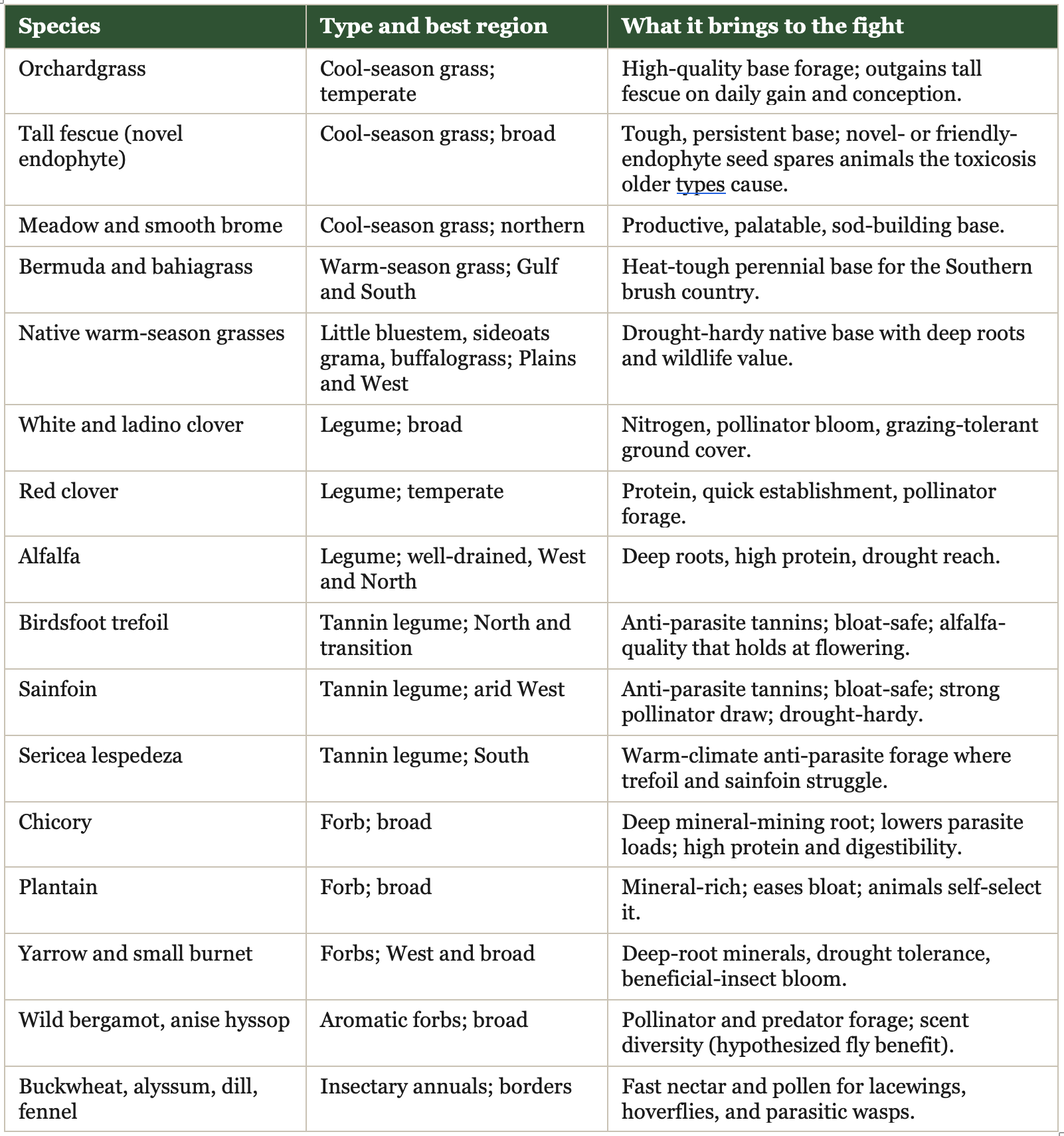
A Working Species Reference
The species below cover most of what a regenerative mix calls on across US grazing regions. Each entry names the layer it fills and the contribution that matters most to this strategy.
Diversity Is the Engine
The mixes in this appendix open with a handful of species, the conventional starting point. Regenerative graziers push much further, running fifteen to thirty or more species in a single planting. The reason sits below ground: each plant family feeds a different slice of the soil food web, and stacking many of them builds the biology that powers the whole strategy.
Soil-health practitioners organize the diversity around four functional groups: cool-season grasses, warm-season grasses, cool-season broadleaves and legumes, and warm-season broadleaves and legumes. A mix carrying several species in each group keeps living roots in the ground across more of the year, spreads root architecture from fibrous mats to deep taproots, and feeds a wider range of microbes and mycorrhizal fungi. Greater functional-group richness raises soil carbon, aggregate structure, water infiltration, and natural disease and pest suppression, the same gains that carry the Resilience Dividend of Part IX.[23]
The approach is already proven in the Treasure Valley. Brad McIntyre built McIntyre Pastures near Caldwell, Idaho on exactly this principle, grazing diverse multi-species cover crops with cattle and following them with pastured hens that clean up flies, and running two dozen or more species in the ground. His results read like a summary of this paper: the fields with the best soil health carried through twelve days above one hundred degrees, input costs fell by roughly one hundred dollars an acre, and earthworm counts climbed from fewer than five to as many as twenty per shovelful. He puts the method in a line, that the key is to build soil health through diversity above and below ground.[24]
Read the regional mixes that follow as floors rather than ceilings. Each names a workable core, and a regenerative producer builds on it by stacking more species into every functional group, season after season, until the planting reaches the diversity the soil rewards.
A High-Diversity Example
A full-spectrum cocktail for an irrigated Treasure Valley pasture might draw two dozen species across the four groups. Each goes in at a fraction of its solo rate, for a combined twenty-five to forty pounds an acre, tuned to season and goal.
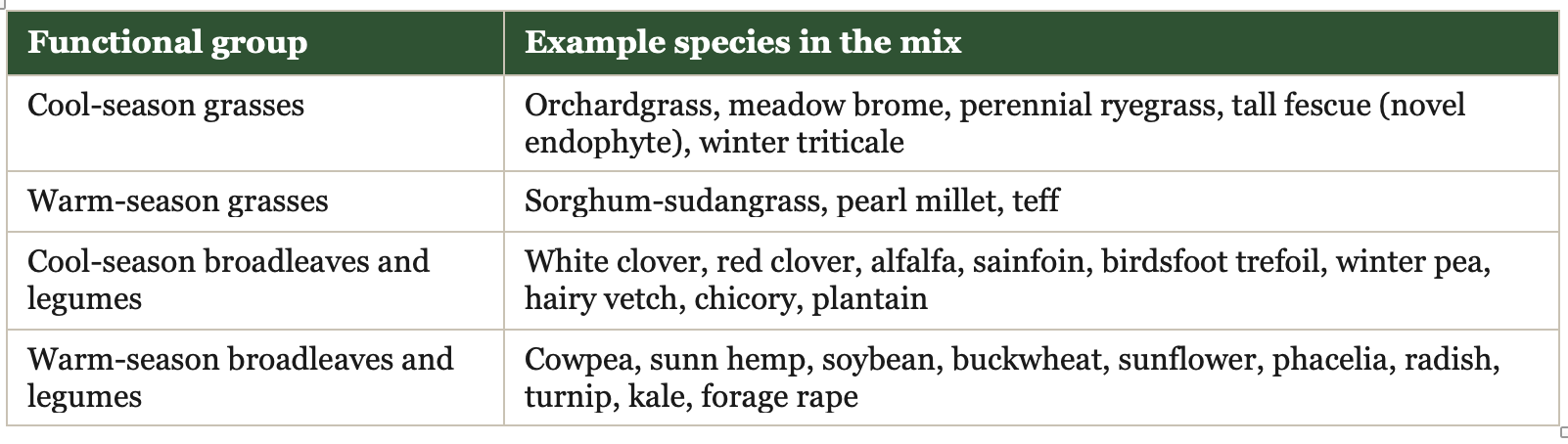
The annual components, the cereals, peas, buckwheat, and brassicas, establish fast and feed the soil in the first year, while the perennials, the grasses, clovers, alfalfa, sainfoin, trefoil, chicory, and plantain, settle in to carry the stand. Match the warm- and cool-season balance to the planting date, and lean on the species reference above to swap in what suits the region.
Maximizing the Herb Layer
Herbs pull triple duty in a mix, which is why a regenerative planting leans on them hard. They feed pollinators and the predatory insects that hunt biting flies, they coat stock with fly-repelling oils as animals brush and rub through them, and many carry minerals and bioactive compounds that grazing animals self-select when they need them. A thick aromatic layer earns its keep several times over, so the aim is to pack in as many as the site will carry.
The palette below sorts the strong herbs by how they belong on the land. Grazeable aromatics go straight into the sward and herb layer. Woody Mediterranean herbs go in as transplants along borders and rub rows, since they root from cuttings rather than seed and the hardest winters cut rosemary back on open ground. A short list of powerful herbs belongs in rub and border plantings alone, where they repel insects hard while staying clear of the graze.
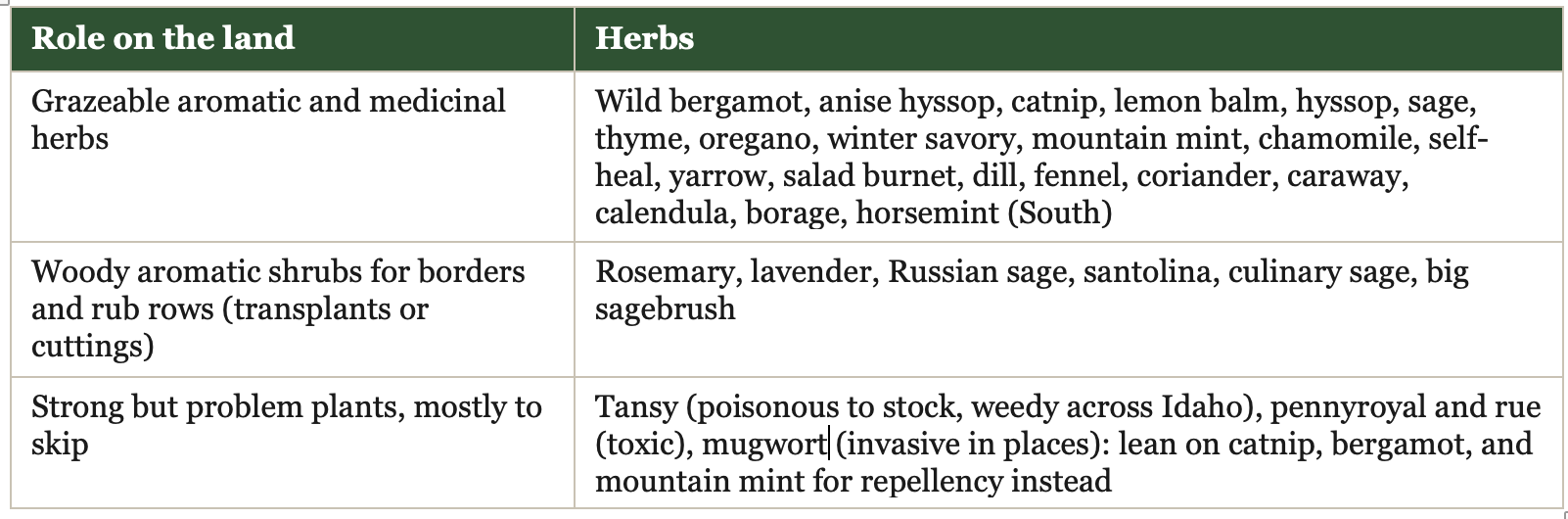
Three habits keep the herb layer working and lawful. Hold the runners to contained borders, since mint and fennel spread hard from the root across open ground. Go light on the strongest-flavored herbs around dairy animals, where wormwood, rue, and the alliums carry into the milk. And clear every species against the state noxious-weed list before planting, since a few strong herbs are restricted. Sow fine herb seed shallow into a firm seedbed or drop it in as plugs along strips, and set the woody aromatics as transplants in the hedgerows and rub rows of Part I, where stock can scratch against them and pick up the oils.
Brassicas and Root Fodder
Brassicas and root crops round out the diversity, and they are the part Brad McIntyre’s fall-grazed cover crops lean on hard. Forage turnip, purple-top turnip, forage and tillage radish, swede, kale, and forage rape grow fast, scavenge loose nitrogen, and put cattle on high-energy bulbs and leaves late into the year, stretching the grazing season the way the Resilience Dividend of Part IX rewards. Their taproots, the daikon-type radish above all, drill through compaction and lift nutrients from the subsoil, opening the ground to water and the next planting.
Fodder beet and mangel add the same late-season feed from a different family, a dense energy root for finishing and winter grazing. As the brassica functional group, these crops feed a distinct slice of the soil biology and carry biofumigant compounds that suppress some soil pests, rounding out the four-group diversity the soil rewards.
Brassicas earn one firm rule. Introduce them gradually and hold them to roughly half the diet or less, balanced with grass, hay, or other fiber, since a sudden heavy brassica load can bring nitrate trouble, bloat, or other disorders. Strip-graze the bulbs behind a fence the animals advance daily, so the fodder lasts and the rumen keeps pace.
Regional and Goal-Based Mixes
The mixes below start from a goal and a region, and each one is a core to build on rather than a finished recipe. They are laid out by layer so a producer can stack many species into each, the heavy-diversity approach of the section above. In a mix this rich, each species goes in at a fraction of its solo rate, for a combined twenty to forty pounds an acre drilled into a prepared seedbed. Match the tannin legume to the climate, since that single choice drives much of the parasite benefit, and lean on a local NRCS agronomist to set the final list and rates.
Confirm the noxious-weed list before planting
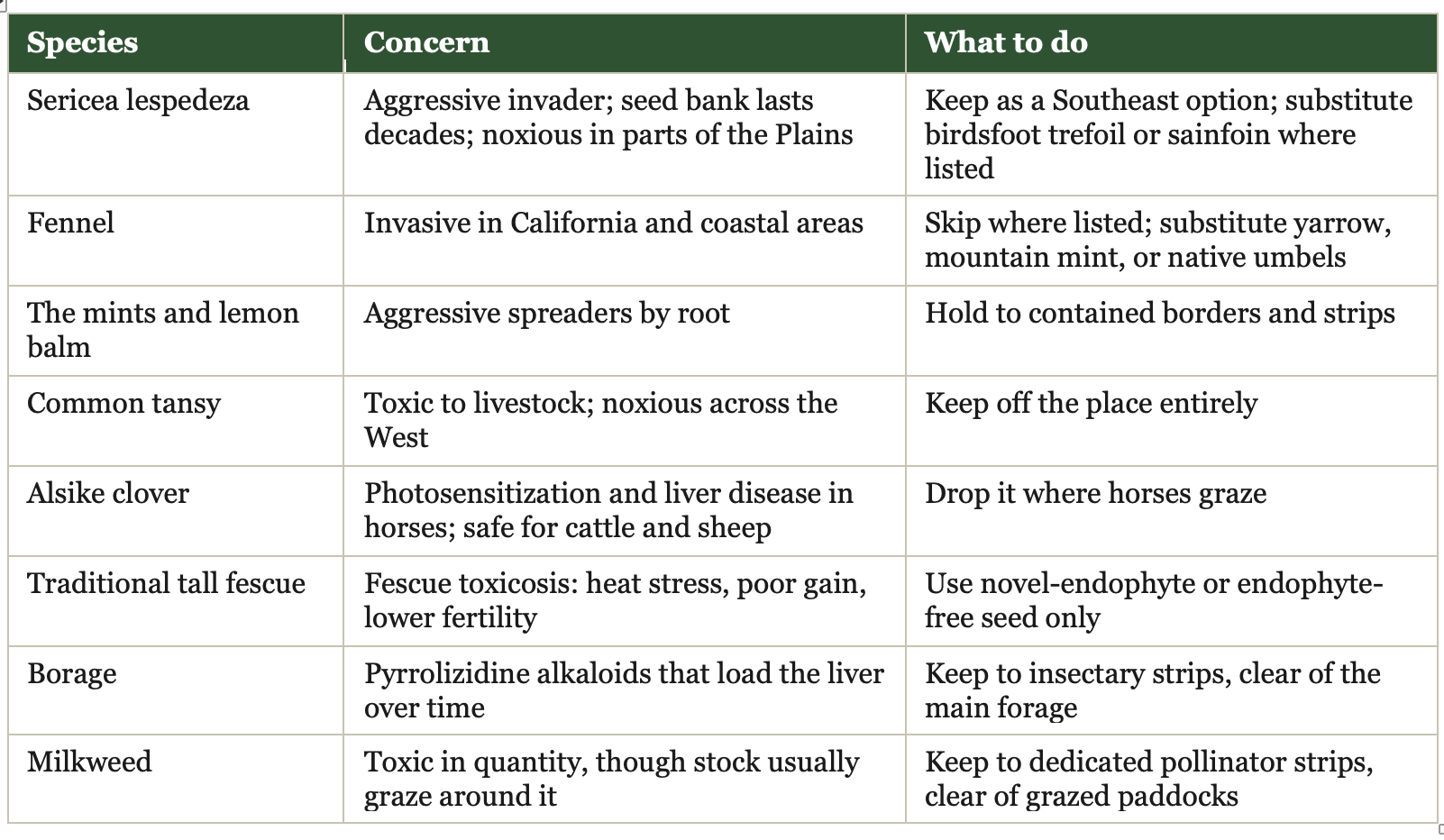
Some plants in these mixes are restricted or invasive in certain states. Sericea lespedeza is an aggressive invader with a seed bank that lasts decades, listed noxious across parts of the Plains, so swap in birdsfoot trefoil or sainfoin where it is restricted.
Common tansy is poisonous to stock and weedy across Idaho and the West, fennel runs invasive in California and coastal ground, and mint spreads hard from the root, so hold it to contained borders.
Check every species against the state noxious-weed list and the local NRCS office before seeding, and choose a regionally native or approved alternative wherever a plant is listed.
Use With Caution
A handful of the species above earn a second look before they go in the ground. Most are a matter of placement, variety, or which animals graze rather than outright danger, and the table screens them at a glance.[25]
1. Southern Brush-Country and Gulf Mix
Built for the Texas and Gulf heat where the fly is active right now. A warm-season perennial base carries summer, cool-season annuals add winter and spring growth, Southern tannin legumes work on parasites, and a broad herb layer feeds beneficial insects and rubs repellent oils onto stock through the long fly season.
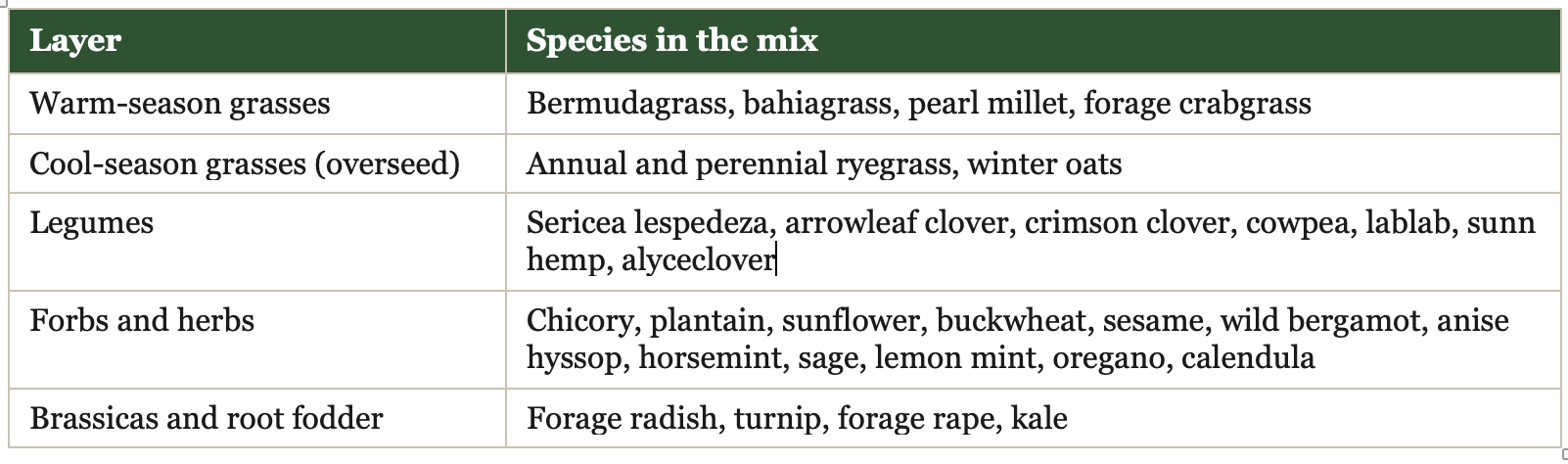
Benefit: dense summer cover and winter legume growth in the region carrying active screwworm pressure, tannin parasite control where shearing and birthing wounds run highest, and an aromatic herb layer that feeds predators and coats stock with repellent oils.
2. Southern Plains Native and Wildlife Mix
A native warm-season range mix for the Hill Country and semi-arid Plains. Deep-rooted natives ride out drought, and a wide native legume and wildflower layer feeds the bird, bat, and insect predators that hold biting flies down. Diverse native range also supports the broader wildlife the fly otherwise exploits as a reservoir.
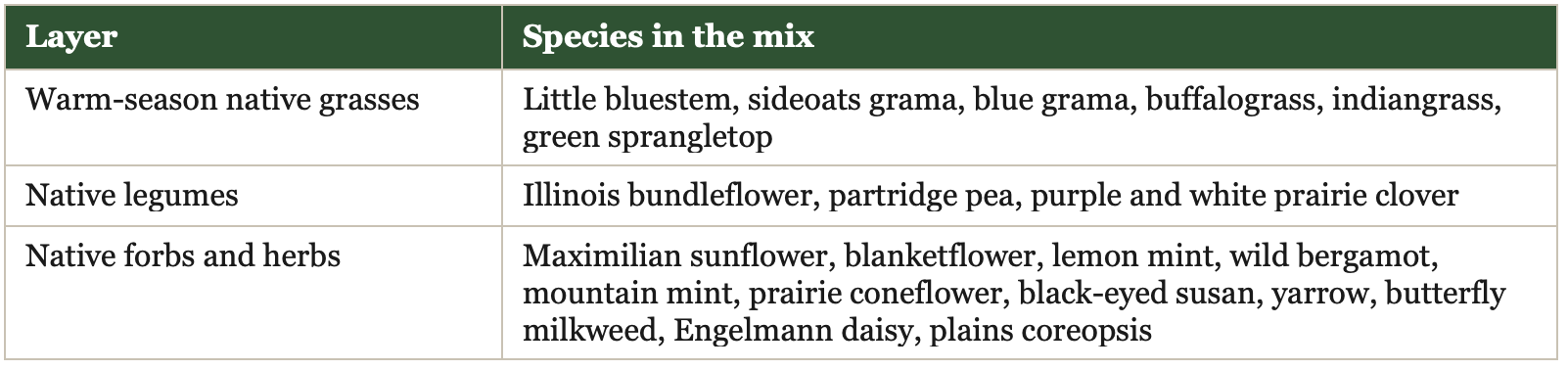
Benefit: drought-resilient cover, deep roots that feed soil life, and a season-long bloom that houses the aerial predators of Parts III and IV alongside quail, pollinators, and game.
3. Cool-Season Diverse Ley
The layered temperate mix of Part II, carried to full diversity for the northern and transition zones. A broad grass base, a stack of legumes, and a deep herb layer give balanced forage, steady nitrogen, mineral mining for wound healing, and aromatic plants that feed beneficial insects and coat stock with repellent oils.
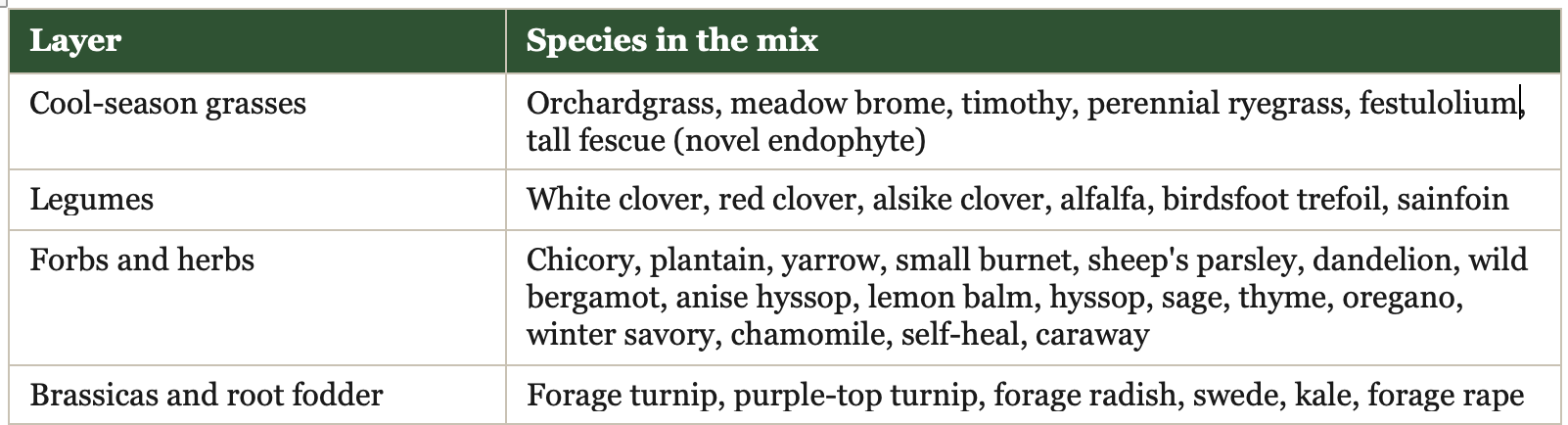
Benefit: a deep, diverse sward that fixes nitrogen, lifts mineral status, blooms across the season for pollinators and predators, and carries a medicinal-herb layer for animal health and self-anointing.
4. Anti-Parasite Small-Ruminant Mix
A tannin- and herb-forward mix for sheep and goats, the animals where shearing and brush wounds run highest. The tannin legume changes with region, and the stand works best once that legume reaches about a quarter of dry matter. Sainfoin pellets halved fecal egg counts in lambs carrying drug-resistant barber pole worm, and over three years more than sixty percent of lambs grazing birdsfoot trefoil stayed dewormer-free, against a third on plain pasture.[26]
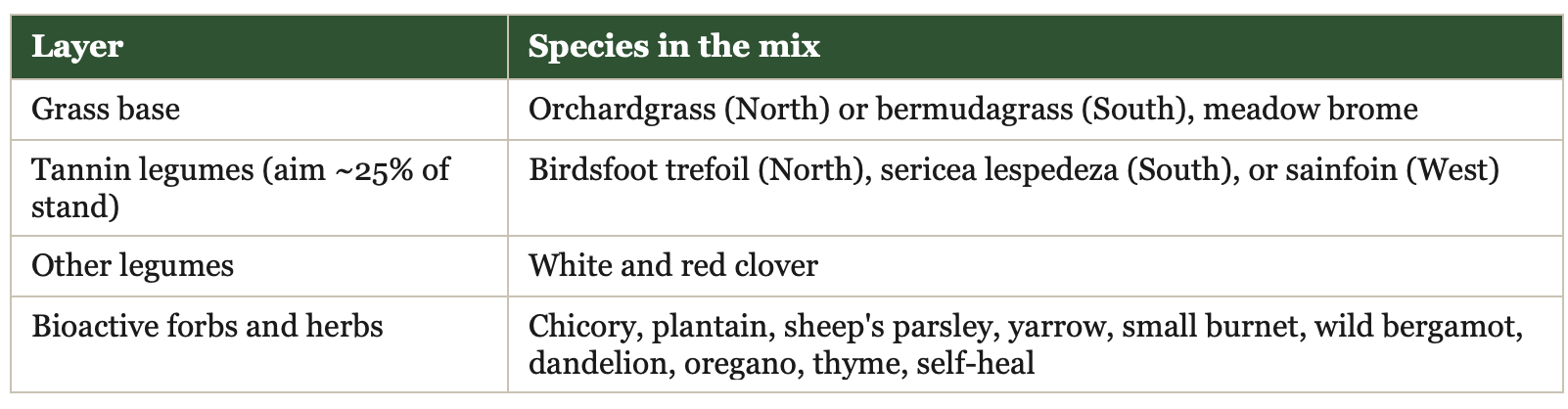
Benefit: a heavy bioactive load that lowers worm burdens, so animals hold flesh and scratch far less, closing the irritation-and-rubbing route to open skin.
5. Pollinator and Insectary Border Mix
A flowering, aromatic mix for field margins, hedgerow understories, and beetle banks rather than the main grazing sward. Continuous bloom feeds the predators and parasitoids that hunt biting flies, and the dense aromatic herb layer carries the scent diversity proposed in Part II.
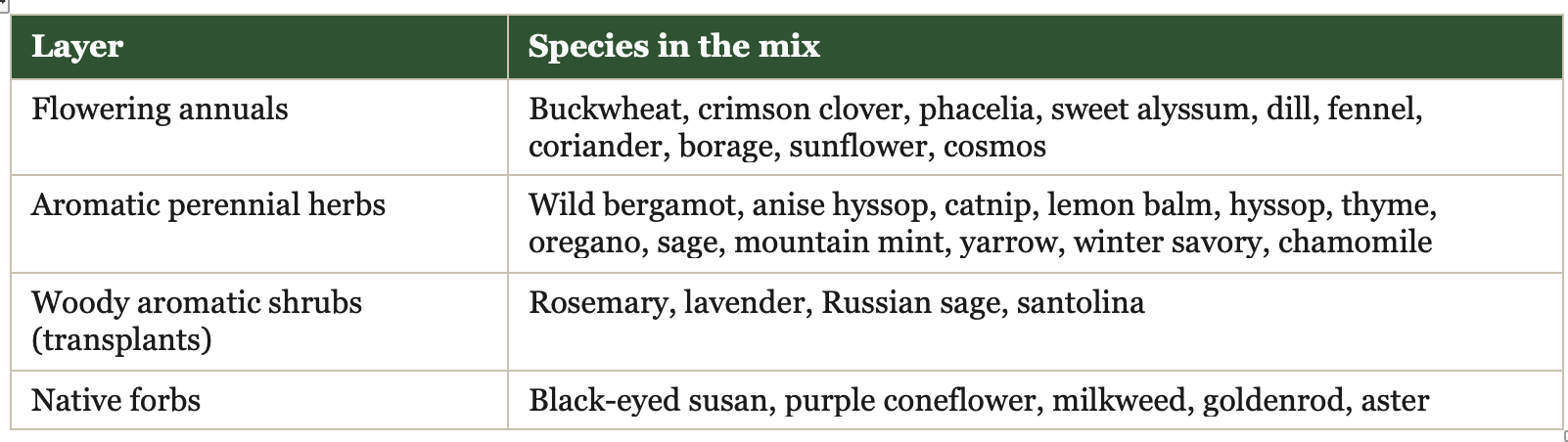
Benefit: a standing reserve of beneficial insects, breeding and present before pest numbers climb, plus a wall of scent that muddies the fly’s search and supplies the rubbing aromatics of Part I.
6. Arid West Drought Mix
A deep-rooted, herb-rich mix for semi-arid rangeland renovation across the intermountain West and the Treasure Valley. Drought-hardy grasses and forbs reach moisture far below the surface, sainfoin adds tannin parasite control and a heavy pollinator draw, and aromatic forbs feed beneficial insects on hard country.

Benefit: resilience through drought, tannin parasite control, deep minerals that build wound-resistant animals, and an aromatic forb layer that draws pollinators and predators to dry country.
Establishment That Sets a Mix Up to Win
A mix succeeds or fails on seed-to-soil contact. Plant small forb and legume seed a quarter to a half inch deep, up to an inch in sand, into a firm seedbed.[27] A few habits carry most new stands through to a grazeable sward:
• Broadcasting rather than drilling? Roughly double the rate to cover seed loss and patchy contact.
• Frost-seed clovers, chicory, and plantain onto late-winter frozen ground, and let the freeze-and-thaw draw them in.
• Rest the new seeding through establishment before grazing; the seed-and-trample, bale-grazing, and overseeding methods of Part VI all build a mix over time.
• Confirm species, rates, and timing with an NRCS office or extension agronomist, since regional fit decides the outcome.
Appendix B: Screwworm Preparedness Checklist
A one-page readiness list. Keep it where the herd records live, and run through it before and during fly season. It gathers the practical steps from across this paper into a single working reference.
Daily and weekly
• Walk the herd and check wounds, body openings, and newborn navels.
• Inspect feet, ears, eyes, mouths, and noses through seed-head season.
• Treat and dress any fresh wound, then watch it daily until it heals.
Supplies on hand
• Wound-cleaning supplies and a navel dip of chlorhexidine or iodine.
• Veterinarian-directed, FDA-authorized screwworm treatment for your species.
• Fly traps, plus repair materials for fences and troughs.
Contacts posted
• Your veterinarian, your state animal health official, and the USDA Area Veterinarian in Charge (find yours through Screwworm.gov).
• Your state’s livestock screwworm reporting line, posted by name and number (Texas, as the first affected state, runs one at 1-800-550-8242).
• Wildlife reporting: USDA Wildlife Services, 866-487-3297, nationwide. General information: Screwworm.gov.
Seasonal timing
• Schedule births and wound-causing work for the cool, low-fly months.
• Mow awn grasses before the seed heads harden; keep loafing areas open and dry.
Movement and biosecurity
• Inspect animals before transport and on arrival; hold new, show, and sale-barn stock apart until checked.
• Honor infested-zone movement controls and arrange any required inspections.
The one rule that overrides the rest
• A suspected screwworm wound is a reportable event. Report it the same day, then keep treating and monitoring the animal.
Prepared as a strategic framework for livestock health and ecological resilience.
— Natalie M. Fleming
[1]USDA APHIS, “USDA Confirms Presence of New World Screwworm in the United States,” June 3, 2026. The calf was treated and survived; larvae were found in the umbilical area, a common wound site in newborns.
[2]CDC Newsroom, “CDC Activates Emergency Operations Center for New World Screwworm Response,” June 11, 2026.
[3]Texas A&M AgriLife Extension, “Livestock Management Considerations for New World Screwworm,” 2025. Risk tiers: high at 80°F+ with 30–70% relative humidity; low below 59°F.
[4]Texas A&M Stories, “What is the New World screwworm, and why does it matter to Texas?” 2025: routine insecticide use is less effective against NWS than against other pests because of its wide host range and presence on wildlife.
[5]Harborth and Gill, Texas A&M AgriLife, in “Producer Preparedness Critical as New World Screwworms Approach,” 2026: the umbilicus is the number-one route of infestation and cause of death in South American livestock; faster navel healing removes the fly’s opportunity.
[6]Washington State University Extension, “Yellow Foxtail — Weed it Out!”; Ohio State University, “Grass Awns Can Cause Significant Medical Problems to Animals,” Ohio BEEF Cattle Letter, 2019; and CowDVM, “Foxtails in Cows.” Awns embed in oral tissue, raise ulcers averaging about ½ inch, and migrate to form abscesses and draining wounds around the head; horses are most susceptible, with cattle and small ruminants also affected.
[7]Utah State University Extension, “Medusahead”; South Dakota State and Montana State Extension medusahead guides; USGS, “Cheatgrass and Medusahead”; and Alligare, “Protection Against Cheatgrass.” Medusahead carries high-silica, barbed awns 30–100 mm long that injure eyes, mouths, and noses; cheatgrass awns cause eye and mouth injuries at maturity. A dense perennial stand is the documented barrier to both.
[8]Uenoyama et al., Science Advances (2021): cats rub against catnip and silver vine and transfer nepetalactol/nepetalactone to the coat, which repels the mosquito Aedes albopictus, an example of self-anointing for insect defense.
[9]Iowa State University research reported by ScienceDaily: nepetalactone, catnip’s essential oil, repelled mosquitoes about ten times more effectively than DEET in testing.
[10]University of Minnesota Extension, “Managing flies on cattle farms”: research is not conclusive on whether predators or parasitoids significantly suppress fly populations on their own. They work best as one layer among several.
[11]Bornemissza, reported in Knutson, “Dung beetles: Biological control agents of horn flies,” Texas Agricultural Extension Service, 2000, via ATTRA, “Dung Beetle Benefits in the Pasture Ecosystem.”
[12]Broom et al., reported in “Horn Fly: Biology, Management, and Future Research Directions,” Journal of Integrated Pest Management 12(1), 2021.
[13]Cornell Integrated Pest Management program, “Dung beetles combat flies; insecticide overuse harms beetles,” 2025; and Garretson et al., “Feed-through insecticides for pest fly management on beef cattle pastures,” 2025.
[14]FAO, “Screwworm control and eradication in the southern United States of America”: because newborn navels were common infestation sites, breeding was timed so most births fell in cold months when screwworm activity was low or absent.
[15]Texas A&M AgriLife Extension, “Rethinking Livestock Management to Consider Screwworm” and “Livestock Management Considerations for New World Screwworm,” 2025–2026; University of Arizona Cooperative Extension, “Preparing Livestock Producers for New World Screwworm Reemergence.”
[16]Texas A&M AgriLife and University of Arizona Cooperative Extension, 2025–2026: schedule higher-risk procedures such as castration, tagging, branding, and shearing during cooler months; treat and monitor any warm-season wound until fully healed.
[17]EcoFarming Daily, “Managing Parasites in Livestock”: cattle can clean pastures for sheep and goats and vice versa by ingesting host-specific larvae, reducing parasite loads alongside rotation and rest.
[18]University of Minnesota Extension, “Managing flies on cattle farms,” and EcoFarming Daily, “Managing Parasites in Livestock”: poultry following ruminants may disrupt larvae and spread pats, though extension framing is cautious.
[19]“Efficacy of Broilers as a Method of Face Fly Larva Control for Organic Dairy Production,” PMC: broiler larval-control results did not differ from untreated pasture; broilers were reluctant to forage pats under high solar radiation.
[20]USDA APHIS, “Report Suspected Cases of Screwworm,” 2026, and Screwworm.gov. New World screwworm is a reportable foreign animal disease. Report a suspected case to your veterinarian, your state animal health official, or the USDA APHIS Area Veterinarian in Charge; USDA’s reporting page lists every state’s contact. Affected states also stand up their own livestock hotlines, Texas being the first at 1-800-550-8242. FDA emergency use authorizations now cover several species, and treatment runs through a veterinary-client relationship.
[21]USDA APHIS New World Screwworm Response Playbook, 2026: USDA establishes roughly 20-km infested zones with quarantines and movement controls around each detection, administered with the affected state’s animal health agency; warm-blooded animals leave a zone only with authorization and inspection.
[22]USGS, “Cheatgrass and Medusahead,” and South Dakota State University Extension: cured annual grasses form fine fuels that drive a shortened grass-fire cycle (as frequent as every 3–5 years versus a historic 50–100 years), each fire favoring further annual-grass dominance.
[23]USDA NRCS, “Soil Health Principle 3: Plant Diversity,” names four crop groups: cool- and warm-season grasses and cool- and warm-season broadleaves. Research syntheses, including Jones et al., Soil Science Society of America Journal (2025), find that greater cover-crop functional-group richness raises soil carbon, microbial diversity, and aggregate structure.
[24]Brad McIntyre, McIntyre Pastures, Caldwell, Idaho, profiled in Capital Press, “Rebuilding soil health,” 2025; Soil Health Academy and Understanding Ag, 2022; and Morning Ag Clips, 2020. Multi-species cover crops grazed by cattle and pastured poultry; roughly $100/acre saved in reduced inputs; earthworm counts rising from under five to as many as twenty per shovelful; diverse, healthy-soil fields carrying through twelve days above 100°F.
[25]Sericea status from EDDMapS and state noxious-weed lists. Livestock-toxicity notes (alsike clover photosensitization and liver disease in horses, fescue toxicosis from wild-type endophyte, borage pyrrolizidine alkaloids, milkweed cardenolides) follow standard extension and veterinary guidance. Confirm any species with a local veterinarian and the state weed authority before seeding.
[26]VetSustain, “Regenerative Agriculture Practices Provide Benefits for Ruminant Health” (sainfoin: ~50% lower fecal egg counts in lambs with multiresistant Haemonchus contortus); University of Rhode Island OREI trials via Grazing with Leslie (birdsfoot trefoil at ≥25% dry matter; 60%+ of lambs dewormer-free over three years vs ~33% on control).
[27]University of Illinois Extension, Agronomy Handbook ch. 6, and Oregon State University Extension, “Revitalizing your pastures”: small forage seed at ¼–½ inch (to 1 inch in sand); broadcast at roughly double the drilled rate; clover, chicory, and plantain establish well by frost seeding.
HI Natalie, I made a home based fly trap with a 2l plastic brink bottle with an inverted top by placing some rotting meat below water in the bottom. I asked AI why it was so successful and AI answered as follows.
You accidentally built a very efficient volatile scrubber:
Water traps heavy anaerobic gases
But allows the most attractive compounds (DMDS, DMTS, putrescine, cadaverine) to diffuse upward
These compounds have extremely low detection thresholds for blowflies (parts per trillion)
This means your trap is producing a clean, strong, directional plume.
and this plume is very effective up to 300m but also up to 3km downwind if the conditions are right. It also suggested to paint the entrance black as this disorientates the flies exiting strategies. Correct placing of these may help in birthing paddocks and around any concentrations of animals if they can draw the flies to the trap instead of the animal. May help around the house to keep your children safe as well. I did not find it smelly at all unless I was changing the liquid. Hope this helps.